Design and selection guides
Selection


This guide explains how to select screw lengths for bigHead internally threaded collar fasteners (F2/SF2), including thread engagement and installation stack considerations.
Selecting the correct screw length for collar products is about balancing two factors: usable internal thread length (Le) and installation stack thickness.
Follow the steps in this guide to determine the acceptable screw length range for your application.
First, confirm whether the collar is:
Each configuration changes the usable thread length calculation.
Your goal is to choose a screw that fully engages the available internal thread without bottoming out (blind collars) or without over-protrusion (sighted collars).
Usable thread length (Le) is the amount of internal thread available for screw engagement.
Use the correct formula based on the collar type.
For blind collars (standard F2/SF2 products with blind Heads), internal threads run the full collar length (L).
A tip clearance (Lu) is required to avoid screw-to-end contact, which could deform or fail the bigHead.
Le = L – Lu
This is the maximum screw thread that may enter the collar during installation.

Screw length implications for blind collar bigHead fasteners
Sighted collars (standard F2/SF2 products with sighted Heads) allow the screw to pass completely through.
Two constraints apply:
When fastening from the Head side, include 1.2 mm of material thickness in the required screw length.
L + installation stack + 1.2 mm (Head-side material)

Screw length implications for sighted collar bigHead fasteners
Closed blind and closed sighted collar customisations include:
Both reduce usable thread length.
Le = L – Lu
The selected screw must not exceed this amount of engagement when tightened.
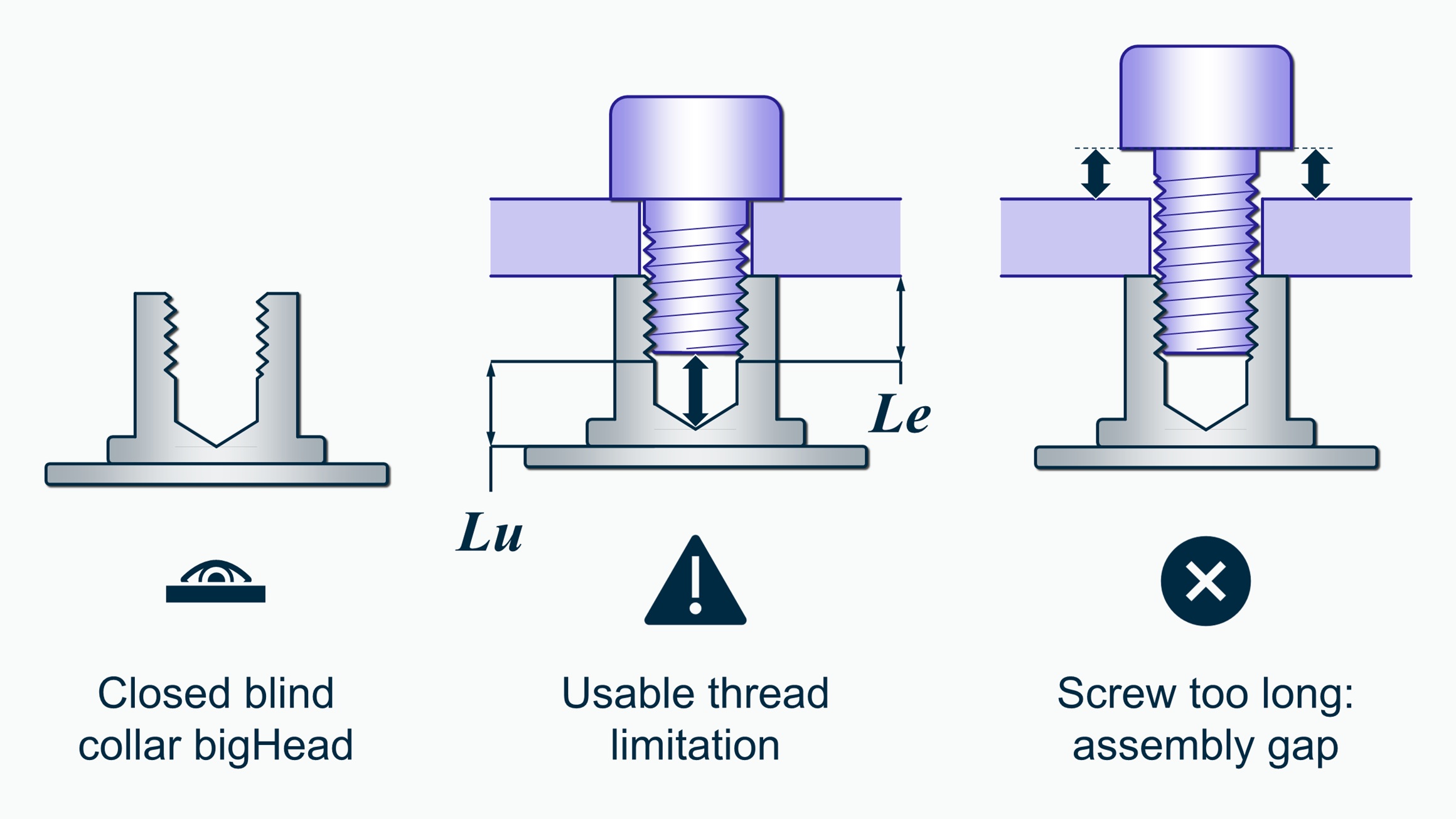
Screw length implications for closed blind collar customised bigHead fasteners
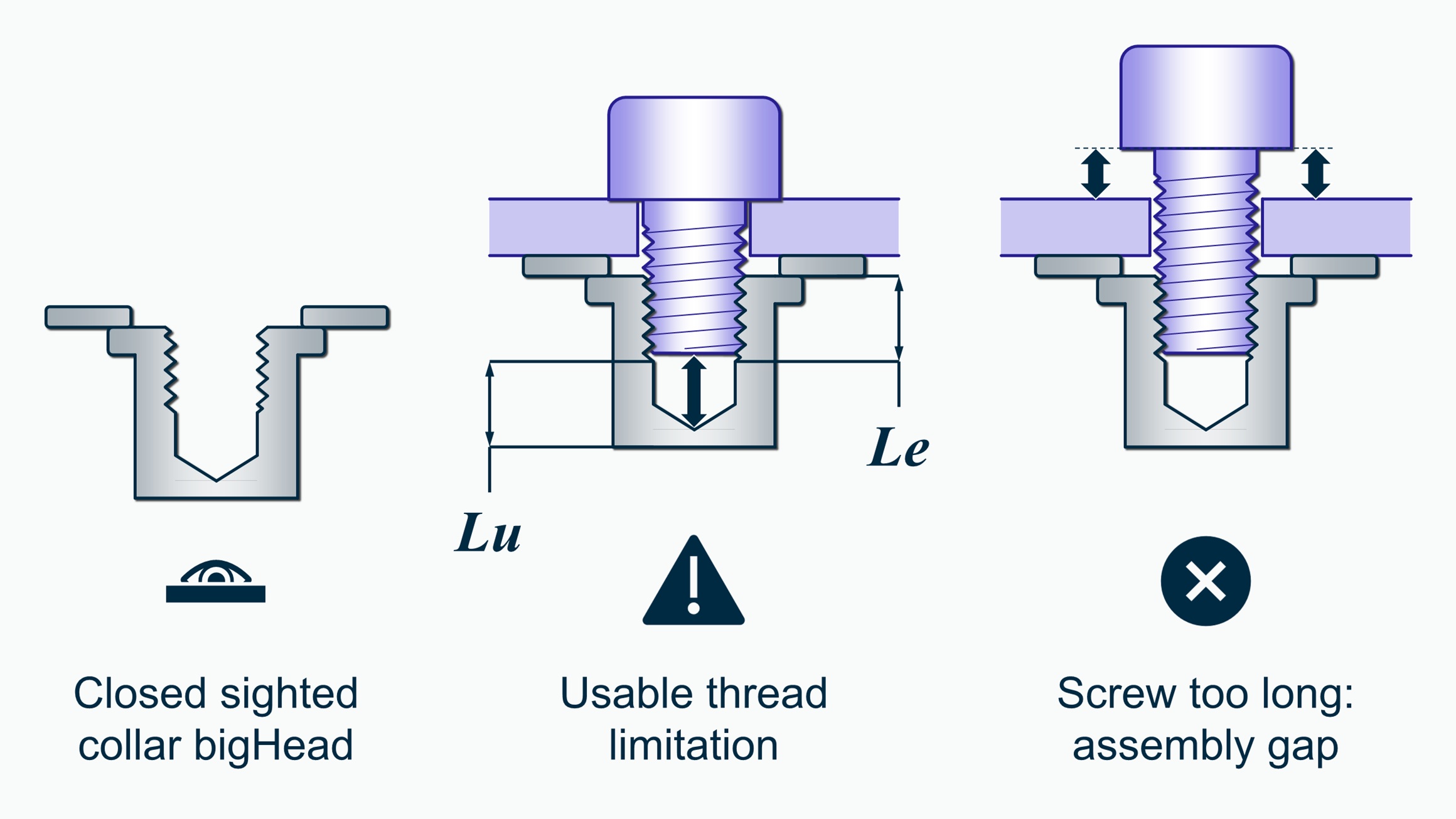
Screw length implications for closed sighted collar customised bigHead fasteners
Consider the full assembly stack-up. Add every physical layer the screw must pass through before engaging the collar. For example:
To avoid bottoming out, the screw must not exceed: Le + installation stack.
The screw must:
These examples show how to calculate suitable screw lengths for common fastening scenarios.
Usable thread length:
Installation stack:
Maximum allowable screw thread length:
Guidance:

Required thread engagement:
Minimum screw length:
Guidance:
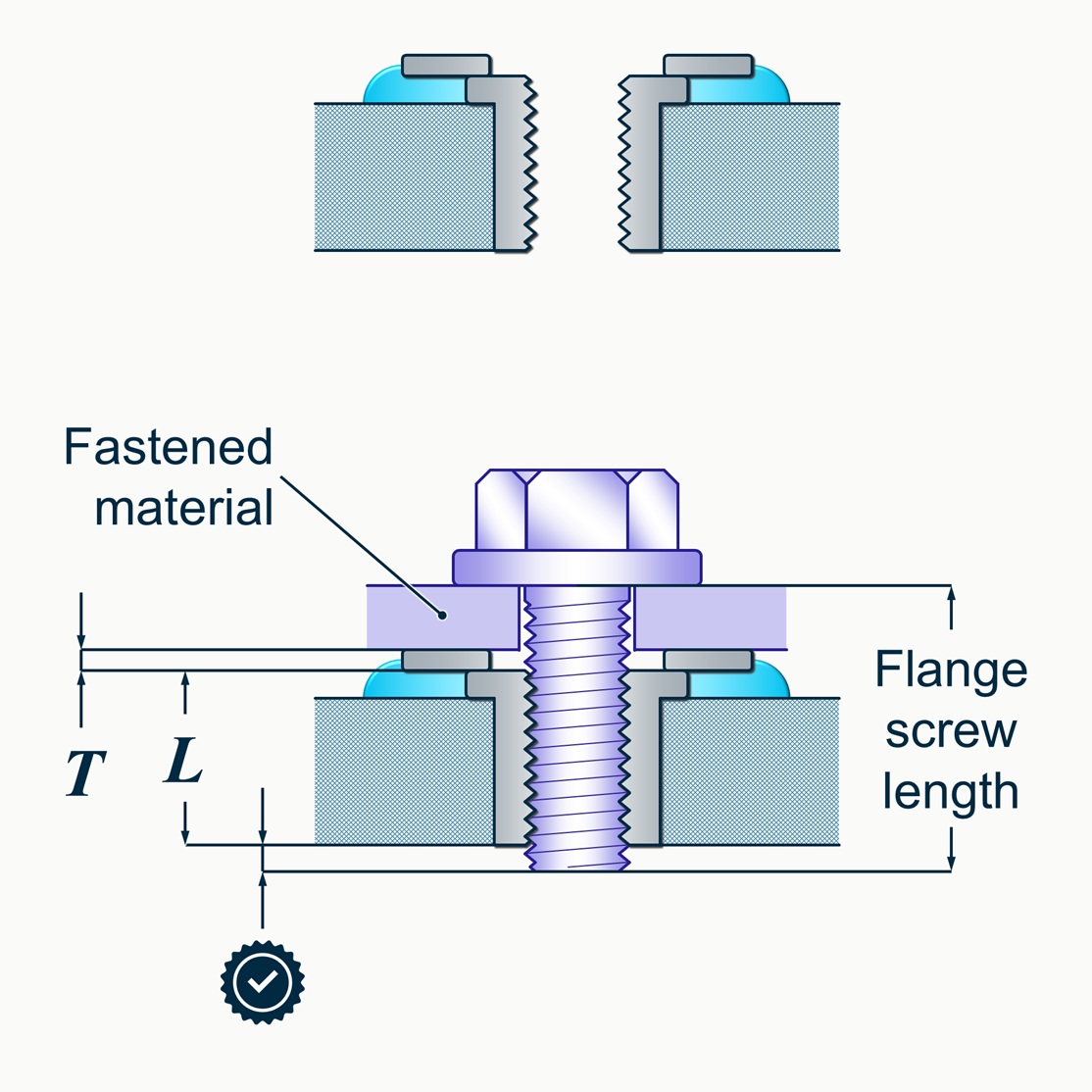
Usable thread length:
Installation stack:
Maximum allowable screw thread length:
Guidance:

Usable thread length:
Installation stack:
Maximum allowable screw thread length:
Guidance:

The screw will bottom out against the closed end, deforming or damaging the bigHead. This is considered misuse and may result in product failure.
Ensure the screw length meets or exceeds the required minimum engagement: L + installation stack + 1.2 mm (if fastening from the Head side).
The examples in this guide show how to calculate it.
The clearance allowance scales with thread diameter and pitch to maintain sufficient deformation protection. Larger threads require greater tip clearance.
Yes. Any component between the screw head and the collar adds to the installation stack thickness and must be included in the calculation.
Yes. bigHead offers custom collar options – including closed, sighted, length variant, and hybrid options. We can help you choose the optimal collar customisation for your application.