
Design and selection guides
Selection

This guide explains how to select ISO 4753 end-forms for bigHead M1/SM1 studs. It compares how chamfered ends (CH), pilot point, flat (PF) and pilot point with truncated cone (PC) support handling, alignment and assembly reliability.
This guide applies to bigHead externally threaded stud (M1/SM1) product types only. It focuses on selecting end-forms for your specific scenario. You can find detailed dimensional and specification information in our ISO 4753 end-forms customisation guide.
ISO 4753 end-form customisation is not compatible with flat point (FL), short dog point (SD) or long dog point (LD) forms, although these forms can look similar to CH, PF and PC. To prevent confusion in this area, we avoid using ‘dog point’ as a generalised term.
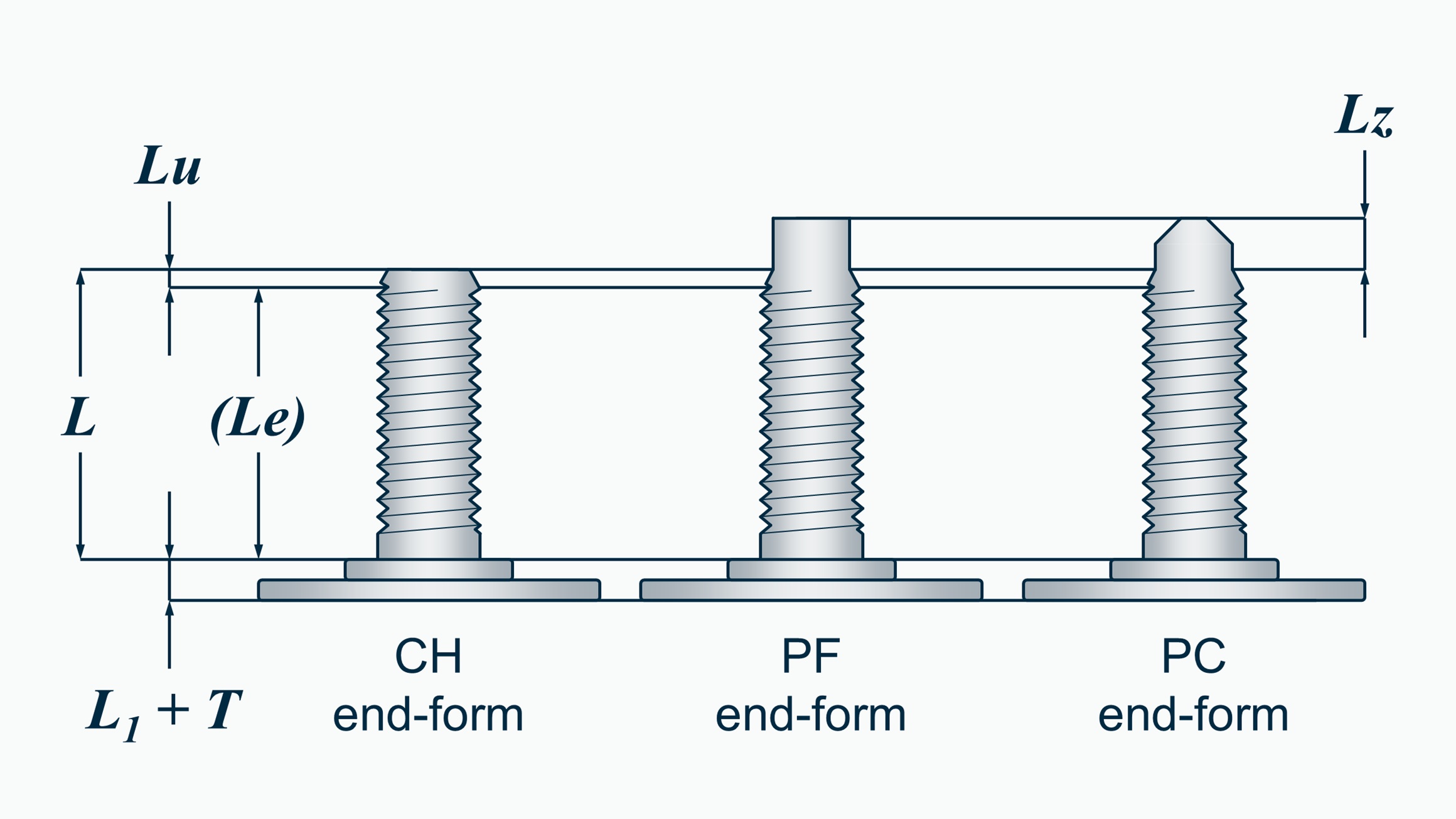
A comparison of the dimensions of CH, PF and PC end-forms for bigHead studs
Consider first the level of automation or assistance you need in your assembly processes.
General-purpose, occasional servicing → choose: chamfered end (CH).
CH is the default choice when enhanced nut running is desirable and no specific alignment constraints exist.
Why:
Repeated servicing, inexperienced operators, low visibility → choose: pilot point, flat (PF).
PF is appropriate when you want better alignment than CH but do not need a tapered locating feature.
Why:
Automated or semi-automated assembly → choose: pilot point with truncated cone (PC).
PC is preferred for automation, robotics, or tight positional tolerances.
Why:
Next, check if the bigHead stud must self-align into tooling, automation or other components.
Do you need the bigHead stud to self-align into automated feeding systems or a tooling feature during manufacturing operations?
Do you need to positively assist the location of bigHead fasteners within slots or holes in assembly components?
Consider any stud length constraints within the assembly design.
For bigHead stud (M1/SM1) products, the end-form treatment affects overall product length differently, depending on the end-form type.
CH does not increase the stud’s overall length. This is the only option that contains all end-form geometry within the nominal thread length (L) and standard stud product envelope.
PF and PC increase overall stud length. The end-form length is additional to the nominal thread length (L), and the increased length depends on thread size (see ISO 4753 customisation guide).
As a general guide:
Design check: If you are considering fitting a PF or PC end-form within an existing standard stud overall length envelope, the usable thread (Le) will reduce. Check that this reduced thread length still provides adequate thread engagement for your application.

Thread engagement differences between standard studs and PF/ PC end-form customised studs of same overall length
Your next step is to evaluate operator usability and ergonomics.
For assembly with gloves, blind positions, or overhead work:
PF and PC provide more reliable findability and tactile alignment because their pilots guide the nut into position with less finesse needed from the operator.
Finally, consider the acceptable level of cross-threading risk in your assembly environment.
We’ve prepared some quick-selection guidance using the following format:
If you need [scenario] → choose [end-form code] → because it will give you [benefits].
No. The standard as‑rolled (RL) end‑form is suitable for most simple manual nut‑fitting applications.
You only need ISO 4753 end‑forms if you’re looking to improve nut lead‑in, reduce cross‑threading risk, or need a high level of self-alignment, particularly in repeated or automated assembly.
The difference is how much alignment and guidance each end‑form provides during different operations.
All three are defined by ISO 4753 and are compatible with bigHead M1/SM1 studs.
Yes – slightly, for a given nominal thread length (L).
All ISO 4753 end‑forms introduce a short length of incomplete thread (Lu) at the stud end, which reduces the usable thread length (Le).
PF and PC also increase the overall stud and overall bigHead fastener length due to the added pilot feature.
These dimensional effects are standardised by thread size, and do not affect load ratings or tightening torque values.
Standard as-rolled (RL) and chamfered (CH) end-forms can feature a slightly recessed or dimpled stud-end.
Flat point (FL) and dog point (SD/LD) can look similar to the above – but they are not suitable for bigHead studs that receive a nut.
Flat point (FL) is intended for screws that bear against a surface. Dog points (SD/LD) are intended for screws that locate into holes or slots. Neither supports reliable nut engagement on a stud.
No. ISO 4753 end-forms do not affect weld load limit (WLL), fixing load limit (FLL) or recommended tightening torque values.
All performance characteristics for end-form customisations are inherited from the standard M1/SM1 product. The end‑form affects physical behaviour, not structural capacity.