Design and selection guides
Design

Embedding bigHead fasteners in discontinuous FRP composites

Embedding bigHead fasteners into discontinuous FRP composite structures such as SMC and BMC requires careful alignment of material thickness, mould-tool shutoff strategy, and fastener geometry.

This guide explains how to design flush, inset, and socket configurations; how to size pockets for thin sections; how to plan spacing; and how to understand expected mechanical performance.

Key takeaways

  • Three embedment configurations are suitable for discontinuous FRP composites: flush, inset, and socket.
  • Flush installations require local section thickness ≥3 mm and controlled shutoff at the shoulder or flange.
  • Inset installations generally provide stronger engagement and remove the shoulder or flange matching restriction, but require section thickness >3 mm.
  • Socket configurations fully encapsulate the fixing and require total section thickness ≥ overall fastener length + 1 mm.
  • Closed blind collar customisation is required for internally threaded fasteners to prevent resin ingress during high‑pressure moulding.
  • Pocketing allows flush installations in thin laminates (<3 mm), provided the pocket thickness is ≥3 mm and allows adequate material flow.
  • Spacing rules are simple: edge and pitch spacing ≥1.5 × Head dimension (or ≥1 × Head dimension for space‑saving edge distances).
  • Mechanical performance is highly substrate‑dependent. Pull‑out values differ significantly between glass and carbon fibre SMC.
  • Pull-out resistance in carbon fibre SMC may exceed fastener design limits, meaning failure can occur in the fastener before the composite. This is expected behaviour.
  • Safety factors and crack‑onset thresholds must be validated experimentally for each material system.

Applicable configurations for embedding bigHead fasteners in discontinuous FRP composites


bigHead fasteners can be embedded in discontinuous FRP using three configuration types:

  • Flush – for thin sections or low‑profile requirements
  • Inset – for stronger embedment where section thickness allows (>3 mm)
  • Socket – for full encapsulation in thick sections (>10 mm)
Applicable configurations and fastening functionalities for bigHead fasteners and discontinuous FRP composites.

Figure 1 – applicable configurations and fastening functionalities for bigHead fasteners and discontinuous FRP composites

Compatible fastener types for embedding in discontinuous FRP composites


Compatible bigHead fastener types for embedding in discontinuous FRP composites are:

  • Flush configuration: externally threaded (M1/SM1), customised internally threaded (F2/SF2 BCL), and pin (M4)
  • Inset configuration: externally threaded (M1/SM1), customised internally threaded (F2/SF2 BCL), and pin (M4)
  • Socket configuration: Customised internally threaded (F2/SF2 BCL) only

When embedding internally threaded fasteners, it is best to use blind installation (where screws do not pass through). Blind Head products are typically used (e.g. F2 B30 or SF2 T38A).

Sighted embedment (where screws pass through) requires additional consideration. We can advise on the optimal solution for your configuration – get in touch.

Required customisation for internally threaded fasteners

Compression‑moulded FRP materials generate high pressures that can force resin into the threaded section of standard collars. For this reason, standard F2/SF2 collars are not recommended for discontinuous‑FRP moulding.

Instead, use our customised closed blind collar (F2/SF2 BCL) to ensure airtightness between the collar flange and Head.

For studs requiring inset shutoff along a cylindrical section, partially threaded studs may be required. We can create these for you if needed.

Design guidance for flush, inset, and socket configurations


Flush configuration for embedding fasteners in discontinuous FRP composites

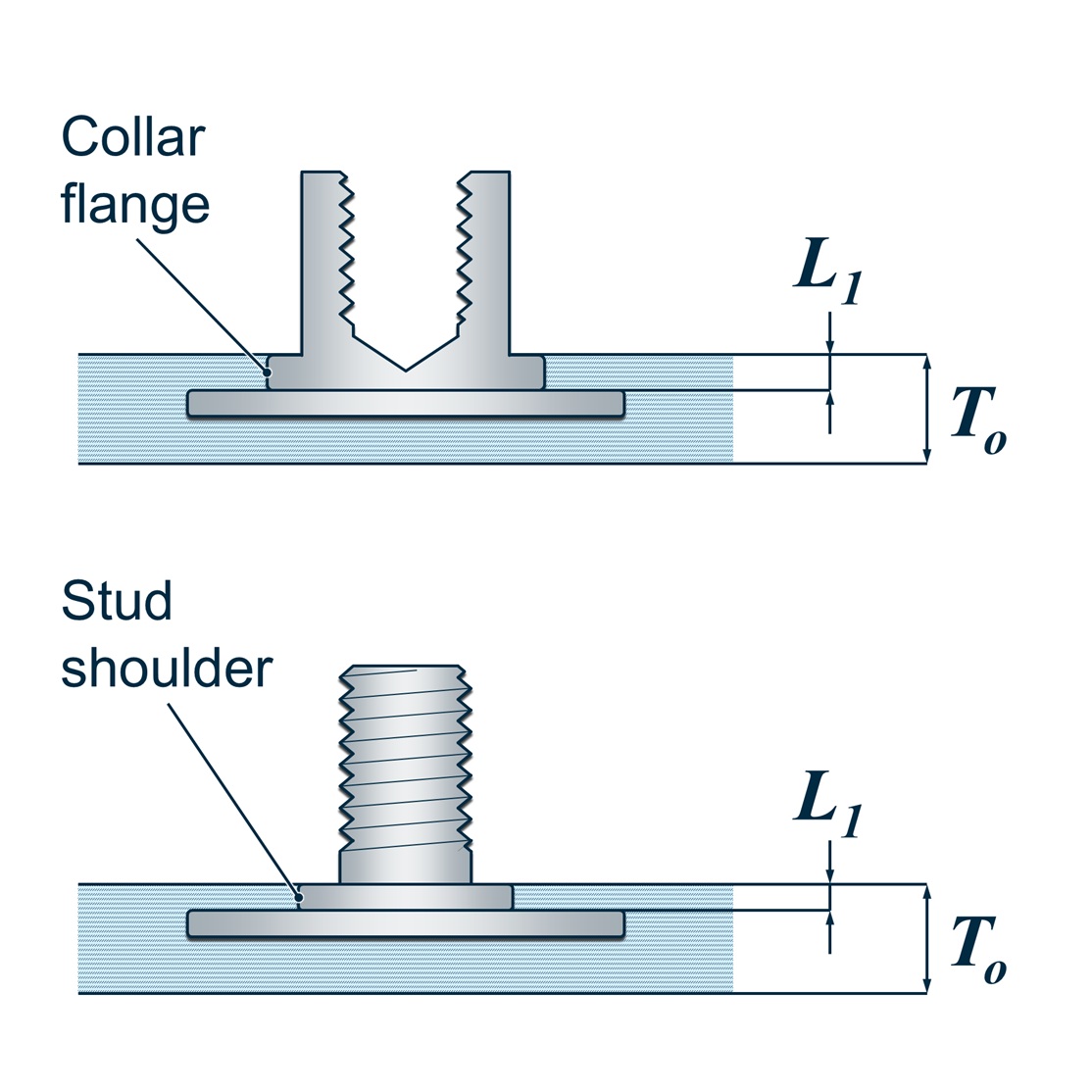
A flush configuration (figure 2) is achievable only when the embedment interface thickness (Te) matches the fixing’s L1 dimension. This allows the mould tool to shut off against the fixing’s shoulder (studs/pins) or flange (collars).

To determine the matching thickness:

  • Studs (M1/SM1) and pins (M4): L1 = shoulder height
  • Collars (F2/SF2): L1 = flange height

To achieve a flush installation:

  • The overall material section thickness (To) must be greater than L1 + Head thickness (T).
  • The practical minimum overall material thickness (To) is 3 mm.
Figure 2 - L1 and To definition for laminate thicknesses with collar (upper) and stud (lower) embedment

Figure 2 – L1 and To definition for laminate thicknesses with collar (upper) and stud (lower) embedment

Pocketed flush installations (<3 mm mouldings)

If the overall composite thickness is less than 3 mm, a flush installation is still possible using a pocket (figure 3):
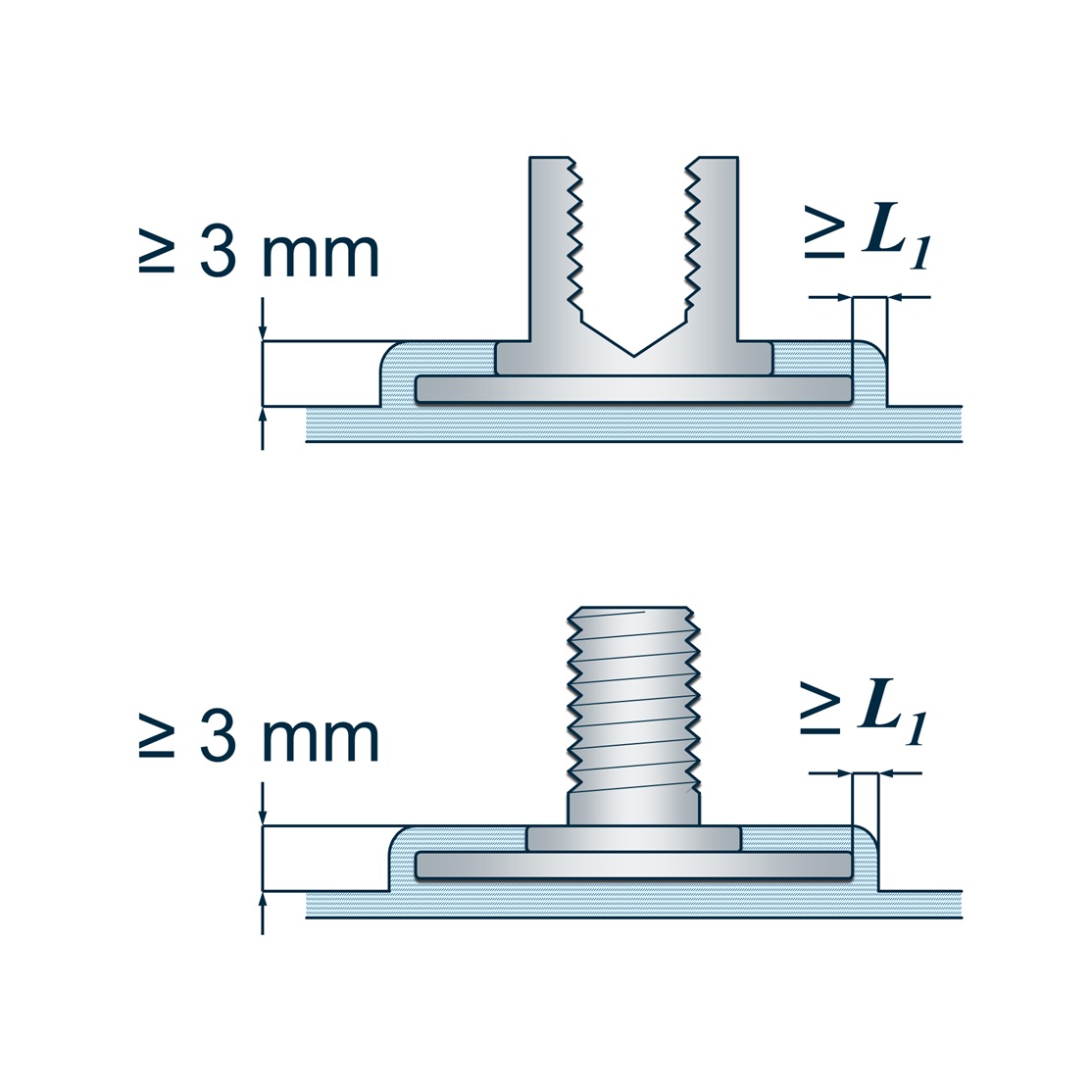
  • Pocket thickness must be ≥ 3 mm.
  • Pocket must allow adequate material flow around the Head.
  • Clearance around the Head should be ≥ L1.
    • For round Heads, use Head diameter A for calculating clearances.
    • For rectangular Heads, use side B or C depending on the clearance direction.
  • L1 matching still applies at the embedment interface.
Figure 3 - recommended pocket sizes for collar (upper) and stud (lower) embedment

Figure 3 – recommended pocket sizes for collar (upper) and stud (lower) embedment

Example: Flush configuration

You are using a bigHead SM1 B23 M6 × 30.

  • Its shoulder height (L1) is 1.2 mm.
  • So, fixing interface section (thickness around stud shoulder) = 1.2 mm.
  • Its Head diameter (A) is 23 mm.
  • Minimum pocket size = A + 2 L1 = 23 mm + 2.4 mm
  • So, minimum pocket size = 25.4 mm diameter.

Inset configuration for embedding fasteners in discontinuous FRP composites

In an inset configuration, the tooling shuts off along the stud/pin shaft or collar shank, rather than at the shoulder or flange (figure 4). This removes the L1 restriction and generally provides stronger mechanical engagement than a flush configuration.

The surrounding material of an inset configuration must fully encapsulate the fixing’s embedded geometry:

  • Studs/pins: encapsulate the shoulder (L1)
  • Collars: encapsulate the flange (L1)
  • All product types: encapsulate the Head thickness (T)

Inset configurations are practical only when material thickness > 3 mm.

Requirement for studs (M1/SM1)

Inset configurations in discontinuous FRP moulding typically require a plain cylindrical section for shutoff.

Standard studs do not include this feature. Please use our Create service if needed.

Figure 4 – tooling shut-off for inset embedment with collar (upper) and stud (lower)

Figure 4 – tooling shut-off for inset embedment with collar (upper) and stud (lower)

Socket configuration for embedding fasteners in discontinuous FRP composites

A socket configuration embeds the full length of the fixing inside the material. This requires additional thickness to maintain material flow around the Head.

Minimum section thickness = overall product length + 1 mm

To calculate the overall length for collar products:

Overall length = collar length (L) + Head thickness (T)

Minimum section thickness with closed blind collar

When using a customised closed blind collar (F2/SF2 BCL) (recommended to prevent thread ingress between the collar and Head):

  • M4 – M8 thread: minimum total section thickness = 12.2 mm
  • M10 – M12 thread: minimum total section thickness = 17.2 mm

Shutoff and sealing options in a socket configuration

1. End‑face shutoff (figure 5):

  • Tooling closes against the flat end of the collar.
  • Only option that achieves a fully flush fit for socket configuration.

2. Shank shutoff (figure 6):

  • Tooling closes against the cylindrical shank.
  • Creates a recess around the shank opening.
  • Recess dimensions depend on tooling and sealing strategy.
Figure 5 – end-face shutoff and flush-fit final form for socket configuration
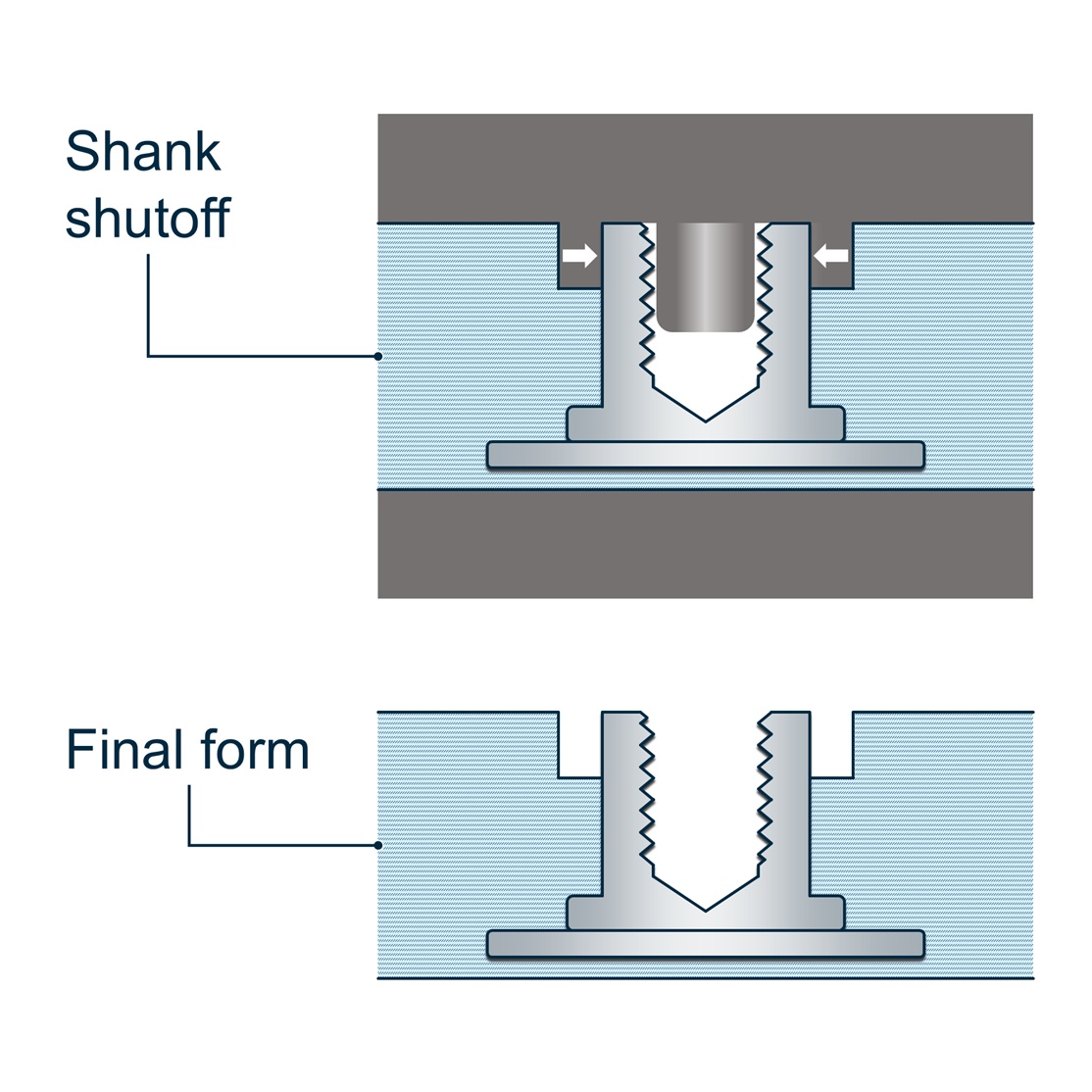
Figure 5 – end-face shutoff and flush-fit final form for socket configuration

Figure 6 – shank shutoff and recessed final form for socket configuration

Figure 6 – shank shutoff and recessed final form for socket configuration

Examples: Socket configuration

Example 1

  • Your total section thickness is 18.5 mm.
  • You are using a bigHead SF2 B30 M8 × 10 BCL.
  • Its overall length = 10 mm (L) + 1.2 mm (T) = 11.2 mm.
  • Minimum section thickness is 11.2 mm + 1 mm = 12.2 mm.

→ OK.

Example 2

  • Your total section thickness is 15 mm.
  • You are using a bigHead SF2 B30 M10 × 15 BCL.
  • Its overall length = 16 mm (L) + 1.2 mm (T) = 17.2 mm.
  • Minimum section thickness is 17.2 mm + 1 mm = 18.2 mm.

→ Not OK

Example 3

  • Your total section thickness is 12 mm.
  • You are using a bigHead SF2 B38A M12 × 15 BCL
  • Minimum section thickness for M12 thread is 17.2 mm

→ Not OK

Fastener arrangement requirements for discontinuous FRP composites


If no application-specific spacing rules exist, use the following simplified rules.

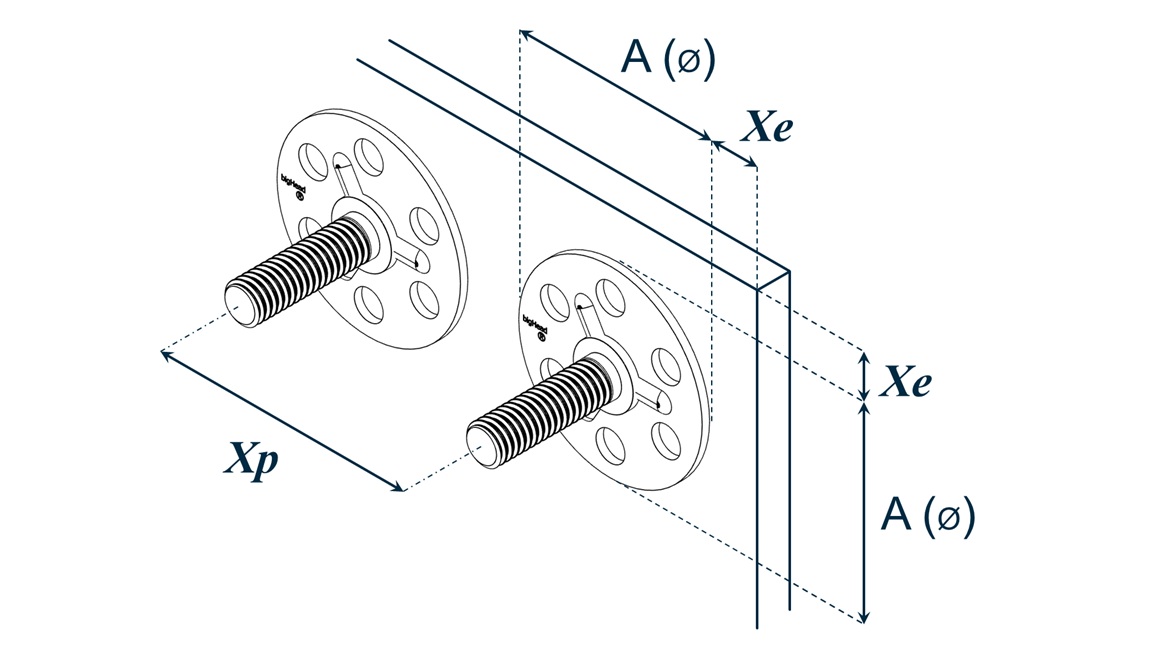
Edge spacing (Xe)

Two approaches are available for edge spacing (Xe):

  • Conservative – prioritises mechanical performance
  • Space-saving – prioritises footprint efficiency

Minimum distance from laminate edge to the fixing’s centreline:

  • Conservative → Xe ≥ 1.5 × Head dimension
  • Space-saving → Xe ≥ Head dimension

Round Heads

For round Heads, spacing is based on the Head diameter A.

  • Conservative → Xe ≥ 1.5A
  • Space-saving → Xe ≥ A

Square/rectangular Heads

For rectangular Heads, use B or C depending on the direction being checked.

  • Parallel to B → Xe ≥ 1.5B (conservative) or B (space-saving)
  • Parallel to C → Xe ≥ 1.5C (conservative) or C (space-saving)

Pitch spacing (Xp)

Minimum centre‑to‑centre distance between fasteners:
  • Xp ≥ 1.5 × Head dimension

Round Heads

  • Xp ≥ 1.5A

Square/rectangular heads

  • Parallel to B → Xp ≥ 1.5B
  • Parallel to C → Xp ≥ 1.5C
Edge (Xe) and pitch (Xp) spacing definition for round bigHead product types

Figure 7 – edge (Xe) and pitch (Xp) spacing definition for round bigHead product types

Edge (Xe b & c) and pitch (Xp) spacings for rectangular bigHead product types

Figure 8 – edge (Xe b & c) and pitch (Xp) spacings for rectangular bigHead product types

Examples: Fastener arrangement

Example 1

You are using a bigHead M1 T38A M8 × 25.

B = 38 mm, C = 15 mm.

Parallel to B:

  • Edge (conservative): Xe ≥ 1.5B = 57 mm.
  • Edge (space‑saving): Xe ≥ B = 38 mm.
  • Pitch: Xp ≥ 1.5B = 57 mm.

Parallel to C:

  • Edge (conservative): Xe ≥ 1.5C = 22.5 mm
  • Edge (space‑saving): Xe ≥ C = 15 mm
  • Pitch: Xp ≥ 1.5C = 22.5 mm

Example 2

You are using a customised closed blind collar (SF2 B30 M12 × 20 BCL).

A = 30 mm

  • Edge (conservative): Xe ≥ 45 mm
  • Edge (space‑saving): Xe ≥ 30 mm
  • Pitch: Xp ≥ 45 mm

Mechanical performance of embedded bigHead fasteners in discontinuous FRP composites


Mechanical performance depends on the fastener type, SMC formulation, and embedment configuration. The following indicative values are based on our laboratory testing of B30 Head fasteners embedded in a 6 mm SMC moulding.

Pull out strength (load to failure)

Glass fibre/vinyl ester SMC

  • Flexural modulus: 13.2 MPa
  • Pull out resistance: ~2 kN
  • Failure occurs in the SMC, as expected for this material class.

Carbon fibre/vinyl ester SMC

  • Flexural modulus: 22.6 MPA
  • Pull out resistance: >4 kN
  • At these loads, the fastener reaches its design limit before the SMC fails.
  • This does not indicate inadequate fastener strength – it indicates that the substrate is strong enough to push the fastener beyond its intended design envelope.

Important note on mechanical performance

FRP materials may show matrix cracking before the fastener reaches its peak load.

Because safety factor and damage tolerance requirements vary by application, we can’t specify whether designs should be based on crack-initiation load or peak load.

Due to the wide range of composite constructions, we also can’t provide crack onset data for embedded bigHead fastening configurations. These thresholds must be established experimentally for each material system.

For more information about testing our products, see our testing and evaluation guides. For specific performance data or support, get in touch.

FAQs