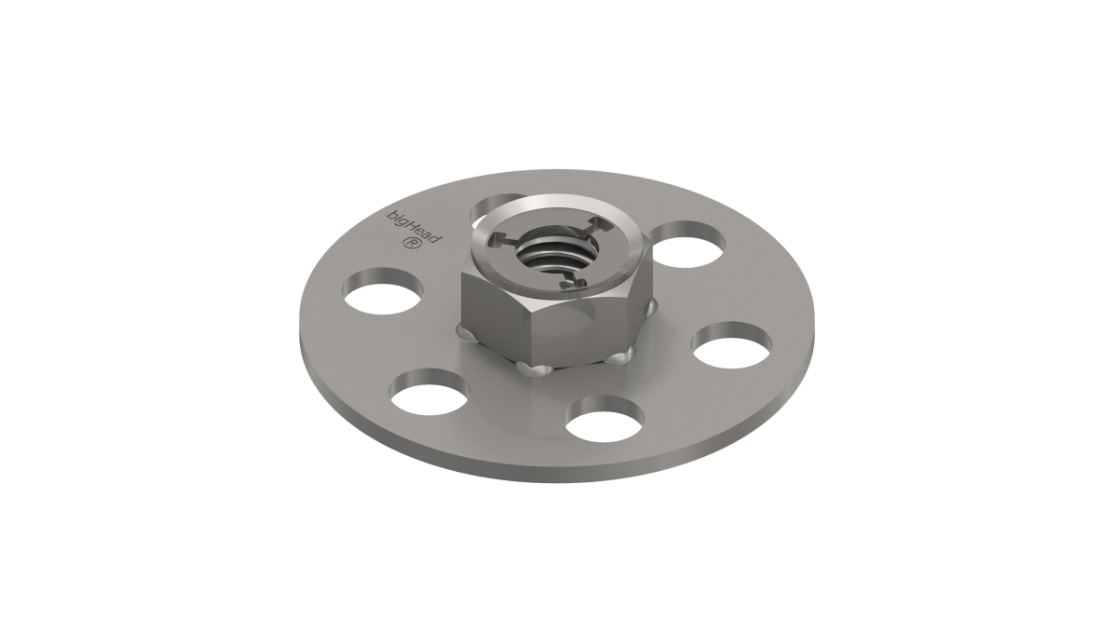
Customisation guides
It replaces the standard F1/SF1 nut with a prevailing–torque lock nut, which incorporates a stainless steel locking element that resists rotation under vibration.

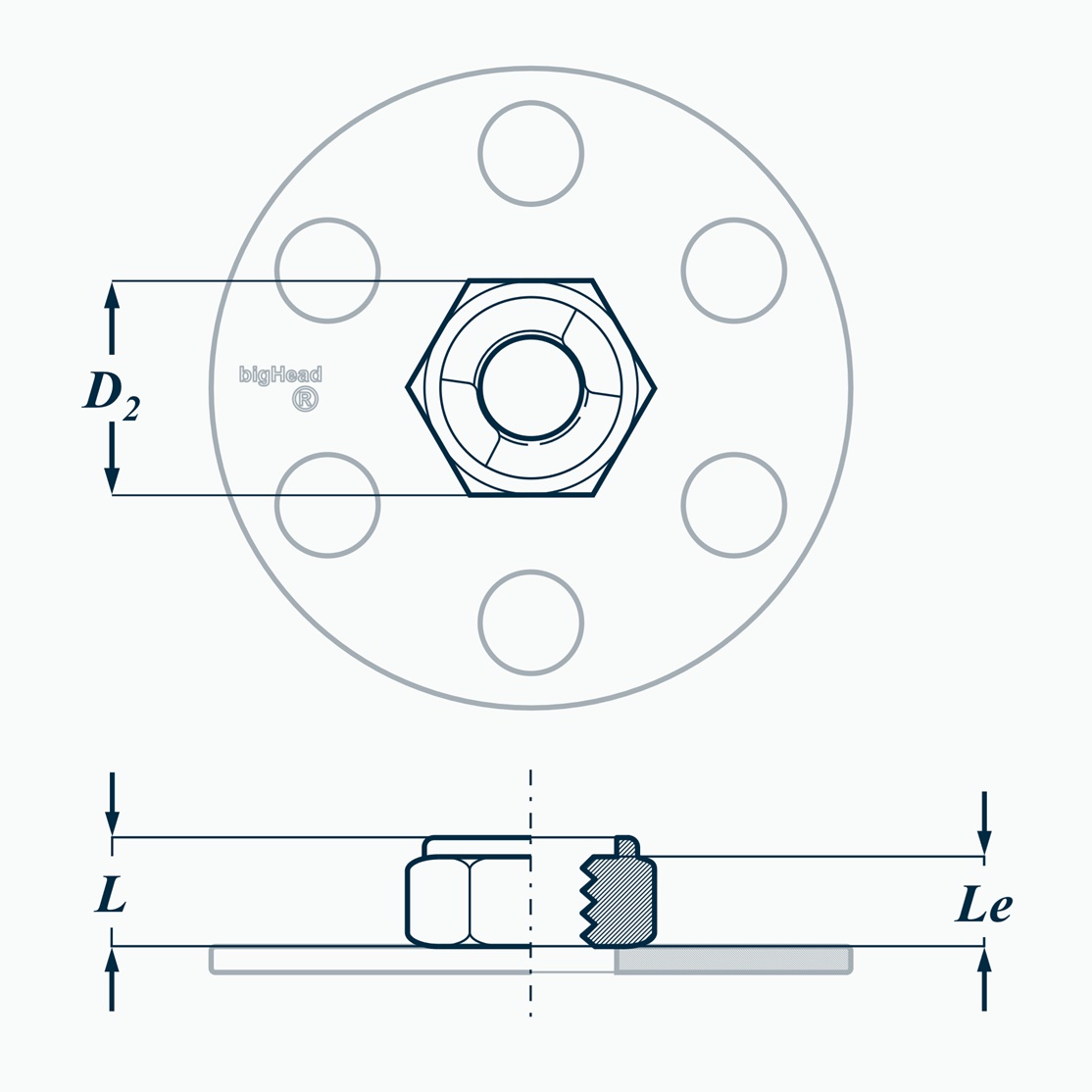
Key dimensions for bigHead with anti-loosening/lock nut customisation
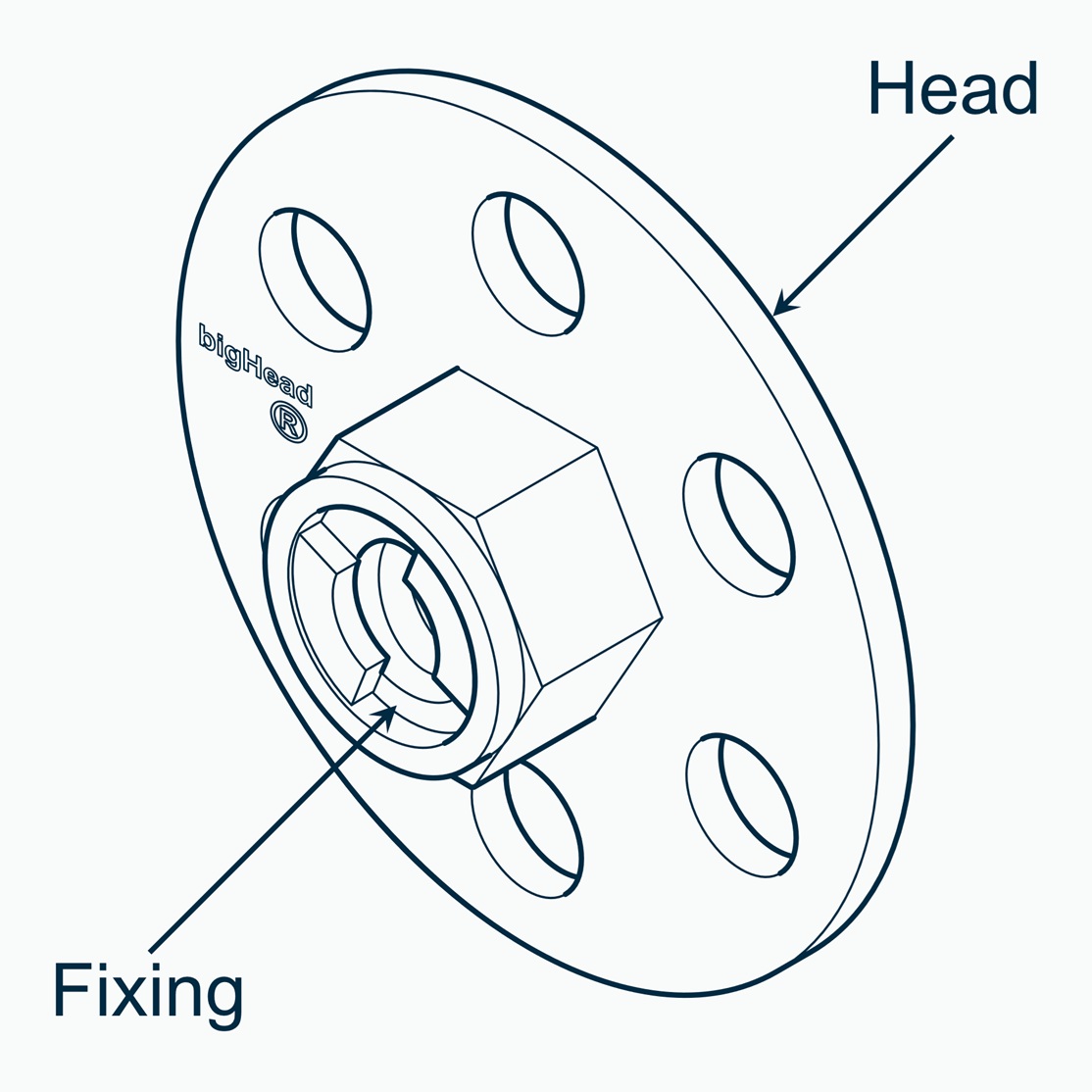
General view of F1/S30 bigHead with anti-loosening/lock nut customisation (SF1/S30 is similar)

Section view of F1/S30 bigHead with anti-loosening/lock nut customisation (SF1/S30 is similar)
This customisation replaces the standard F1/FS1 nut with a fixed‑design, two‑piece, all‑metal prevailing‑torque lock nut.
Due to the lock nut design, it is available for M6, M8, M10 and M12 thread sizes only.
Head options follow standard F1/SF1 availability. The Head type options, by thread size, are:
For carbon steel bigHead products, the nut body is grade 8 carbon steel. For stainless steel bigHead products, the nut body is 316 stainless steel.
Standard bigHead finishes apply (BZP for carbon steel, natural finish for 316 stainless steel).
Some requests are not compatible with anti-loosening customisation, due to manufacturing constraints. Examples:
If you have an out-of-scope request, we can work with you to create a solution – get in touch.
Compared to standard F1/ SF1 products, the key geometric differences are overall nut height (L), thread length (Le), and across flats distance (D2).
Values for these dimensions, by thread size, are:
If you’re not sure how this affects your assembly, get in touch.
To specify anti-loosening customisation on a round S20 Head with M6 thread size:
→ F1/S20 M6 PTS
To specify anti-loosening customisation on a square S32 Head with M10 thread size:
→ SF1/S32 M10 PTS
A request for anti-loosening customisation of an SF1/B20 M4 product is not possible through our customisation service. Instead, we can create a solution for you through our Create service.
It replaces the standard F1/SF1 nut with a prevailing–torque lock nut, which incorporates a stainless steel locking element that resists rotation under vibration.
Yes. The lock nut design uses different geometry, and the associated WLL and tightening torque values are not the same as standard products. We can supply the correct values for your specification on request.
Prevailing–torque lock nuts introduce additional friction via a mechanical locking feature, increasing the running torque required during assembly.
M6, M8, M10, and M12 only. M4 and M5 are unavailable through this route due to our product manufacturing limitations. Contact us to ask about alternative options for M4 or M5 thread sizes.
Possibly. The lock nut design has different height and thread engagement lengths, so you may need a slightly longer screw to ensure proper engagement with the locking feature.