

Automotive and EV
Pop‑top roofs for campervans are a fast‑growing market. These roofs are typically GRP laminate structures, often with gel‑coat finishes on both sides to achieve the smooth appearance expected by the end user. As production volumes rise, designers are looking for fastening solutions that maintain visual quality while supporting fast, repeatable assembly.
Design and manufacturing challenge
A pop‑top roof requires multiple attachment points, often used to secure interior components such as handles or curtain rails.
The design requirements are clear:
- No visible fasteners on the exterior moulding
- No through‑bolting that breaks the clean outer surface
Many manufacturers use surface‑bonded fasteners. In more flexible production environments, such as hand lay‑up or vacuum infusion, this approach works well. Surface bonding offers strong attachment and design flexibility without complicating the laminate design or forming.
One of our customers was producing 60 pop‑top roofs per week, with 26 fastening locations per roof. At that scale, adhesive bonding introduced positioning variability and additional clean‑up steps that became increasingly difficult to manage within the available time window.
As production increased and fastener installation became a repeated manufacturing operation, the cumulative impact of bonding each fastener cleanly, accurately and consistently began to affect their throughput.
Each fastener required:
- Precise spacing
- Controlled adhesive application
- Cure time
- Careful handling to avoid rotation or misalignment
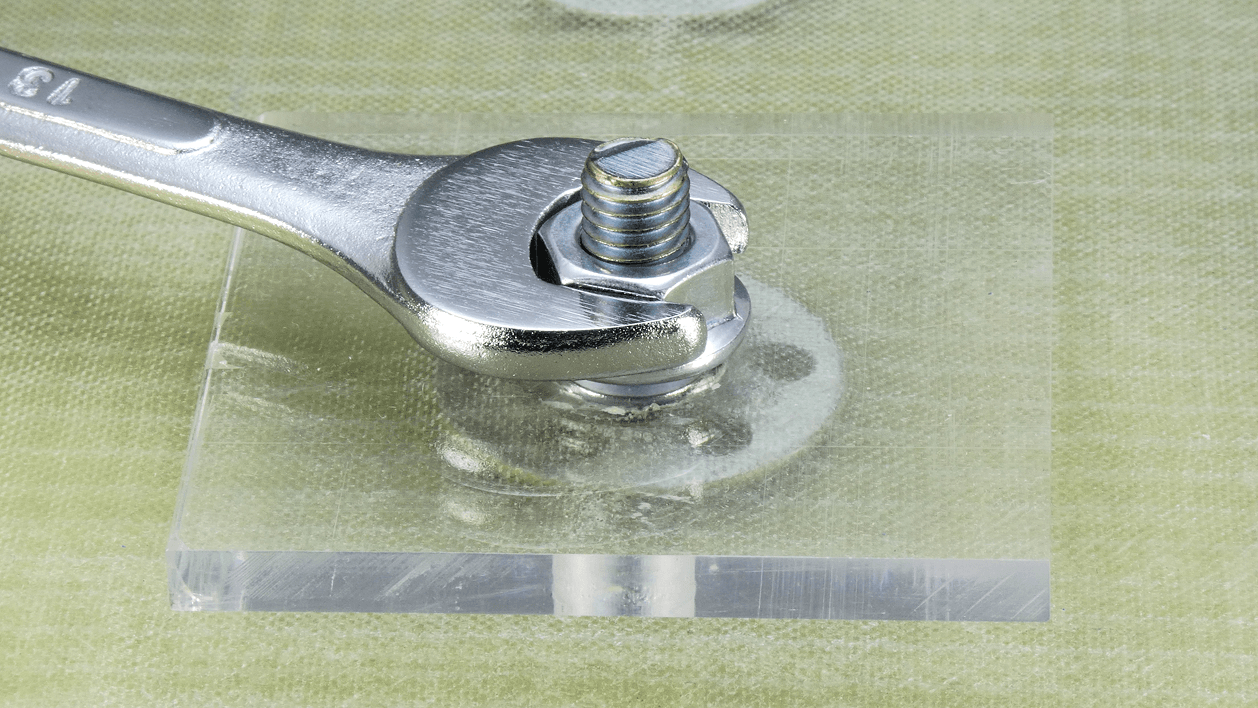
bigHead stud fastener flush-embedded in GFRP, receiving a nut to secure the fastened component.
Why embedding became more appropriate for this production context
Rather than treating fastening as an isolated task, the team evaluated it within the context of their evolving manufacturing workflow.
They needed a blind fastening method, but they also needed to increase throughput without compromising the exterior surface.
As they transitioned towards rigid tooling and RTM processing, the process itself now supported embedding. At this point, process efficiency and consistency began to drive the choice.
When they compared surface bonding with embedding, the advantages for their production context became clear. Embedding would:
- Remove the repeated adhesive‑bonding operation
- Reduce handling steps
- Improve consistency of fastener positioning
- Support the cycle times required for higher‑volume production
Embedding also eliminated bond lines and the risk of adhesive overspill. And crucially, it removed the need to individually bond 26 fasteners per roof.
For this customer, embedding a standard bigHead fastener provided a clean, repeatable solution. They mould the inside and outside surfaces simultaneously using a solid tool, with the bigHeads embedded directly into the laminate. The tooling controls spacing and alignment, ensuring consistent results.

The outcome: a cleaner, faster manufacturing process
For these customers, embedding delivered clear benefits:
- Eliminated visible fixings on the exterior GRP surface
- Removed several individual bonding operations per roof
- Reduced rework by minimising rotation, misalignment and adhesive‑related variability
- Supported higher production volumes
- Enabled cleaner, more efficient assembly workflows
Surface bonding remains an effective option for many manufacturers, particularly those using hand lay‑up or vacuum infusion. But in this case, the shift to RTM meant that embedding became the more efficient and sustainable choice for the customer’s production context.