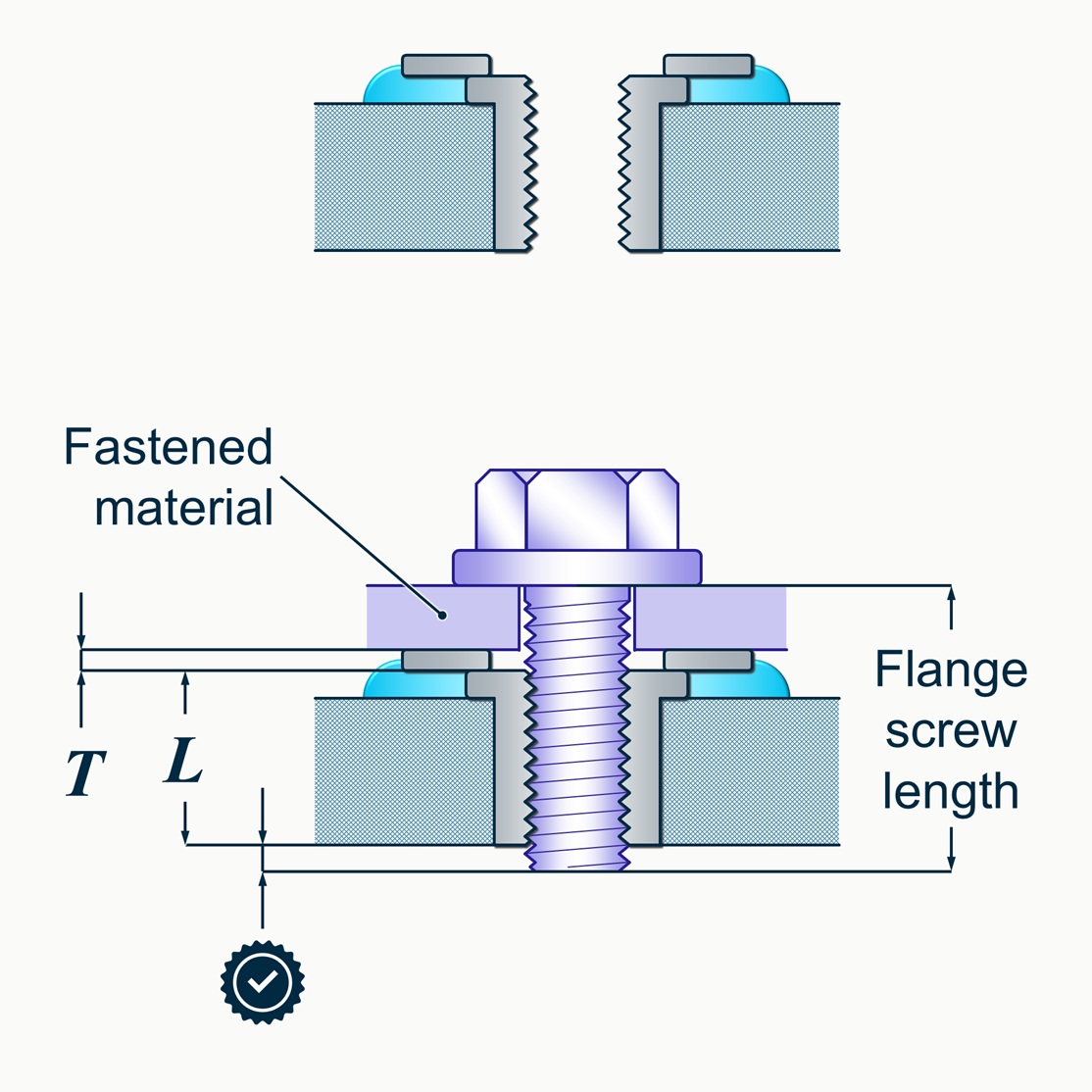
The screw will bottom out against the closed end, deforming or damaging the bigHead. This is considered misuse and may result in product failure.
This guide explains how to select screw lengths for bigHead internally threaded collar fasteners (F2/SF2), including thread engagement and installation stack considerations.
Selecting the correct screw length for collar products is about balancing two factors: usable internal thread length (Le) and installation stack thickness.
Follow the steps in this guide to determine the acceptable screw length range for your application.
Key takeaways
- Always calculate usable thread length (Le) before selecting a screw. Le varies by collar type and thread size.
- Blind collars require screw tip clearance (Lu) to avoid deformation from screw-to-end contact.
- Closed blind and closed sighted collars include an unthreaded bore, reducing Le more than standard products.
- Sighted collars allow full pass-through, but minimum engagement and clearance space beyond the collar must be checked.
- Installation stack thickness matters. Section, adhesive, washers, and flange thicknesses all reduce available screw engagement.
- Do not exceed the maximum allowable thread length in blind configurations – this is the most common cause of installation failures.
- Undersized screw lengths risk incomplete engagement, reducing mechanical performance and installation reliability.
- When in doubt, calculate using the simple sequence:
Le → + stack thickness → compare screw length against min/max limits.
1. Confirm the collar type
First, confirm whether the collar is:
- Blind
- Sighted
- Closed blind, or
- Closed sighted
Each configuration changes the usable thread length calculation.
Your goal is to choose a screw that fully engages the available internal thread without bottoming out (blind collars) or without over-protrusion (sighted collars).
2. Calculate usable thread length (Le)
Usable thread length (Le) is the amount of internal thread available for screw engagement.
Use the correct formula based on the collar type.
Blind collars
For blind collars (standard F2/SF2 products with blind Heads), internal threads run the full collar length (L).
A tip clearance (Lu) is required to avoid screw-to-end contact, which could deform or fail the bigHead.
Recommended screw tip clearances (Lu):
- M4: 1.4 mm
- M5: 1.6 mm
- M6: 2 mm
- M8: 2.5 mm
- M10: 3 mm
- M12: 3.5 mm
Usable thread length:
Le = L – Lu
This is the maximum screw thread that may enter the collar during installation.
Screw length implications for blind collar bigHead fasteners
Sighted collars
Sighted collars (standard F2/SF2 products with sighted Heads) allow the screw to pass completely through.
Two constraints apply:
- Minimum thread engagement: the screw should engage the full collar thread length.
- Pass-through clearance: any portion of the screw protruding beyond the collar must not interfere with the surrounding assembly.
When fastening from the Head side, include 1.2 mm of material thickness in the required screw length.
Minimum screw thread length:
L + installation stack + 1.2 mm (Head-side material)
Screw length implications for sighted collar bigHead fasteners
Closed blind or closed sighted collars
Closed blind and closed sighted collar customisations include:
- A closed end wall thickness
- A fixed unthreaded bore section
Both reduce usable thread length.
Unthreaded bore length (Lu):
- M4–M8 → 5 mm
- M10 → 6 mm
- M12 → 7 mm
Usable thread length:
Le = L – Lu
The selected screw must not exceed this amount of engagement when tightened.
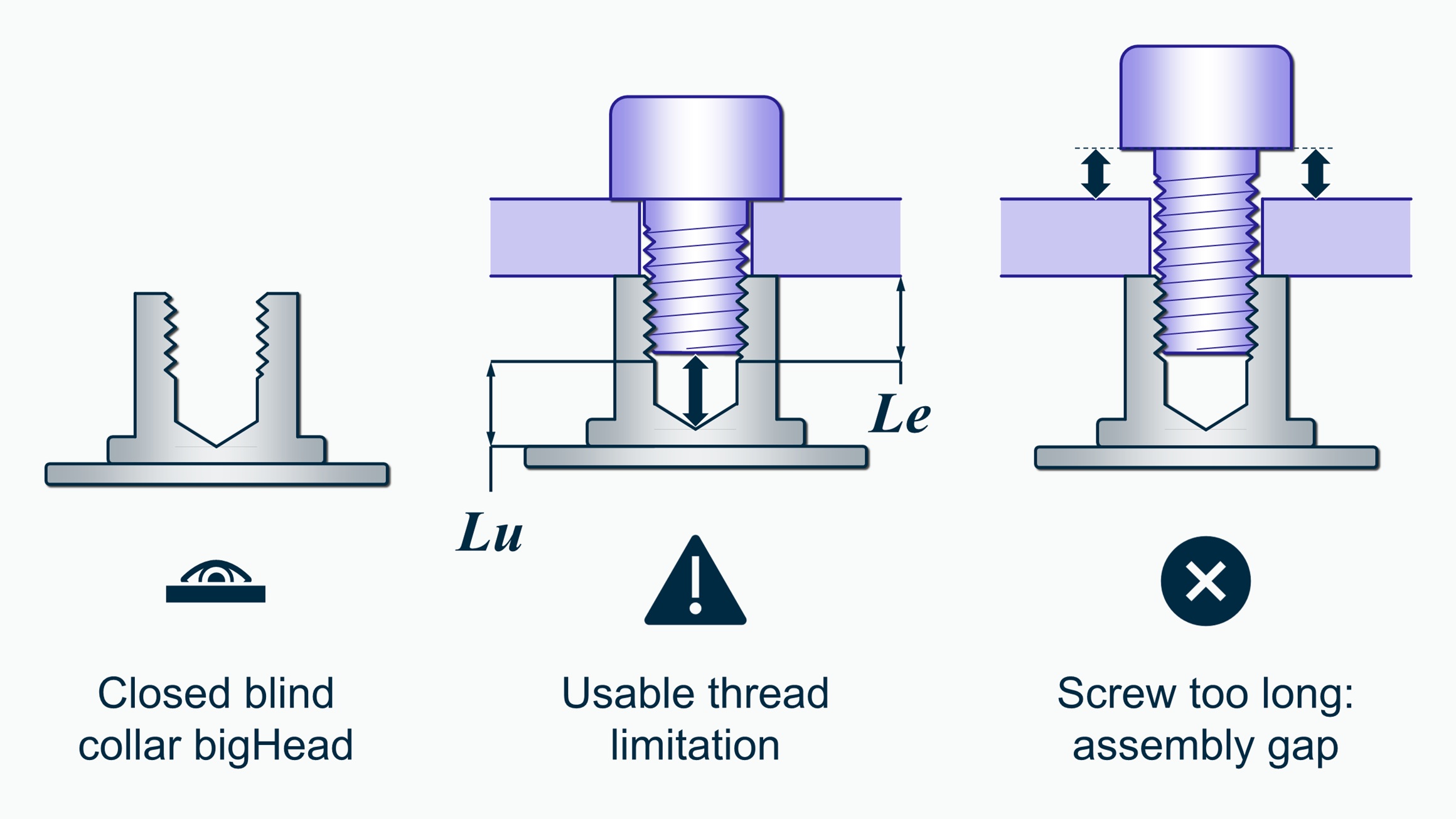
Screw length implications for closed blind collar customised bigHead fasteners
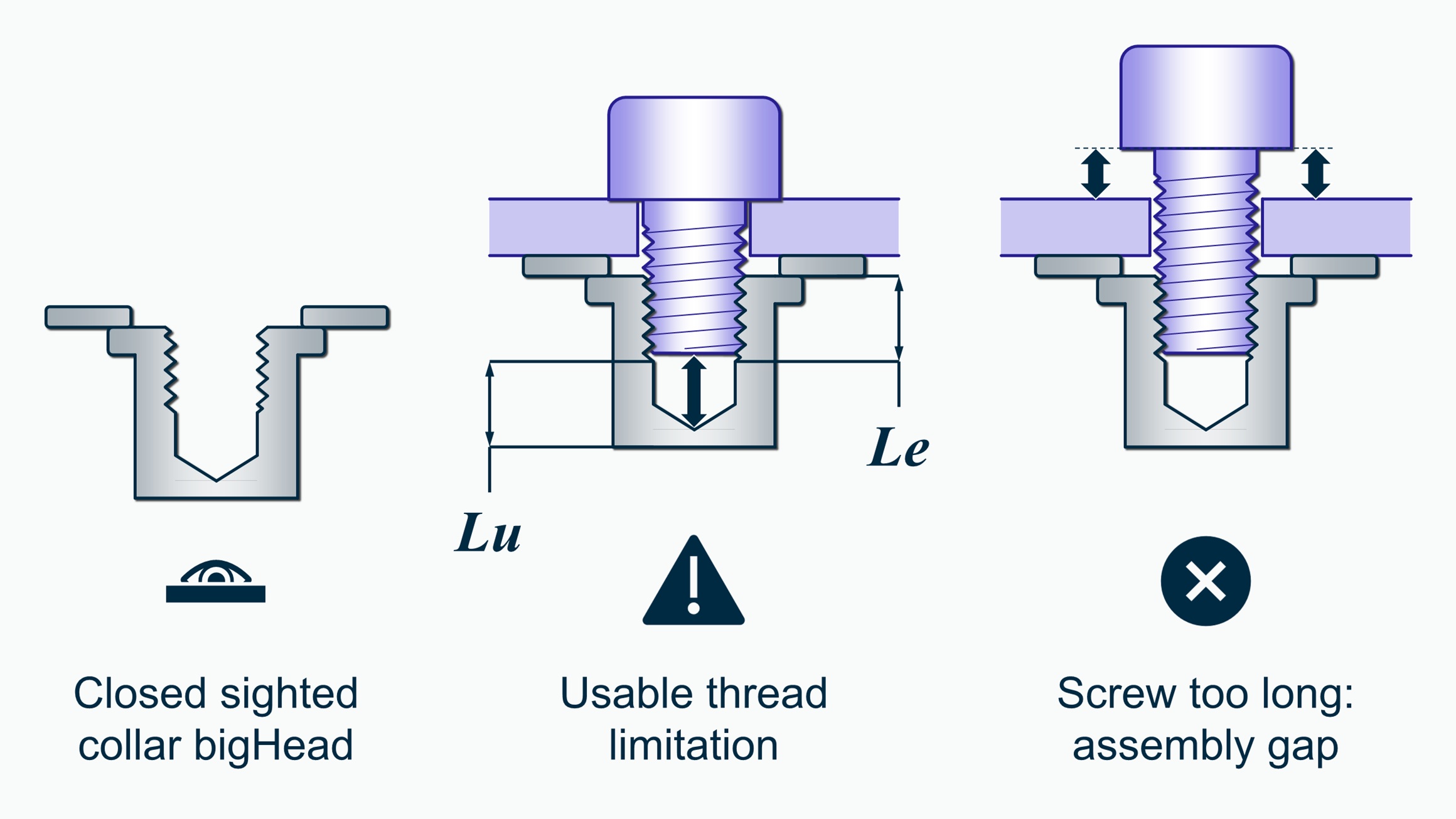
Screw length implications for closed sighted collar customised bigHead fasteners
3. Calculate installation stack thickness
Consider the full assembly stack-up. Add every physical layer the screw must pass through before engaging the collar. For example:
- Section thickness
- Adhesive layer (if surface bonded)
- Washers
- Flange thickness
- Head‑side material allowance, if applicable (see step 2)
4. Combine Le and stack thickness to identify screw length range
Blind collars
To avoid bottoming out, the screw must not exceed: Le + installation stack.
Sighted collars
The screw must:
- Meet or exceed the minimum engagement requirement: L + installation stack + 1.2 mm (if fastening from the Head side).
- Not protrude excessively beyond the collar.
Examples
These examples show how to calculate suitable screw lengths for common fastening scenarios.
- Product: F2 B20 M6 × 20
- Configuration: surface bonded, standoff
- Fastens: 5 mm section + washer (1.6 mm)
Usable thread length:
- Lu (M6) = 2 mm
- Le = 20 – 2 = 18 mm
Installation stack:
- 5.0 + 1.6 = 6.6 mm
Maximum allowable screw thread length:
- 18 + 6.6 = 24.6 mm
Guidance:
- ≤24 mm → OK
- ≥25 mm → too long: risk of bottoming out
- Product: SF2 S30 M8 × 15
- Configuration: surface bonded, socket
- Fastens: 3 mm section (flanged screw, no washer)
- Front-face installation adds: 1.2 mm Head thickness
Required thread engagement:
- 15 mm collar length
Minimum screw length:
- 15 + 3 + 1.2 = 19.2 mm
Guidance:
- ≥20 mm → OK (check for excess protrusion)
- ≤19 mm → incomplete engagement (not recommended)
- Product: F2 S23 M5 × 10 BCL (customised)
- Configuration: embedded, flush
- Fastens: 2.5 mm section + 1 mm washer
Usable thread length:
- Lu (M5 closed blind) = 5 mm
- Le = 10 – 5 = 5 mm
Installation stack:
- 2.5 + 1.0 = 3.5 mm
Maximum allowable screw thread length:
- 5 + 3.5 = 8.5 mm
Guidance:
- ≤8 mm → OK
- ≥9 mm → too long: do not use
- Product: SF2 S38A M10 × 20 CL (customised)
- Configuration: Surface bonded, socket
- Fastens: 9 mm section (flanged screw, no washer)
- Rear-face installation adds: 1.2 mm Head thickness
- Adhesive bondline adds: 1 mm thickness
Usable thread length:
- Lu (M10 closed sighted) = 6 mm
- Le = 20 – 6 = 14 mm
Installation stack:
- 9 mm
Maximum allowable screw thread length:
- 14 + 9 + 1.2 + 1 = 25.2 mm
Guidance:
- ≤25 mm → OK
- ≥26 mm → too long: do not use
FAQs
-
What happens if the screw is too long in a blind collar?
-
How do I know if my screw is long enough for a sighted collar?
Ensure the screw length meets or exceeds the required minimum engagement: L + installation stack + 1.2 mm (if fastening from the Head side).
The examples in this guide show how to calculate it.
-
Why is tip clearance (Lu) different for each thread size?
The clearance allowance scales with thread diameter and pitch to maintain sufficient deformation protection. Larger threads require greater tip clearance.
-
Do washers or flanged screws affect screw length selection?
Yes. Any component between the screw head and the collar adds to the installation stack thickness and must be included in the calculation.
-
My application requires a specific engagement length. Can I request a custom collar design?
Yes. bigHead offers custom collar options – including closed, sighted, length variant, and hybrid options. We can help you choose the optimal collar customisation for your application.