

Aerospace and UAV
Lightweight UAV sandwich structures offer exceptional strength-to-weight performance. But they leave almost no margin for error when it comes to fastening. Even a small tightening force can crush the core. And a relatively small loading across a small area can disbond the skins.
Unmanned air vehicles (UAVs) are increasingly being designed with thin composite sandwich panels to maximise payload capacity and flight efficiency. These structures can be just millimetres thick, and every gram matters.
In this project, our customer needed reliable mounting points inside the payload module of a medevac drone. The challenge was simple to describe but difficult to solve:
How do you fasten into a structure so light that even pushing on it can damage it?
The problem: a fastener that could crush the structure
The customer first approached us for tightening-torque guidance on an internally threaded fastener bonded to the back of the sandwich panel.
They recognised the risk of crushing the core during assembly, and wanted to understand how to avoid it.
Once we reviewed the material properties, it became clear that:
- The allowable tightening torque was less than 1 Nm
- Most tightening methods have greater inaccuracy than that
- Even a slight over-tightening could crush the sandwich core
- Alternative fastener installations could cause skin disbonding
In short, the fastening method they were considering was too delicate to control, and too risky for a flight-critical component.
They needed mounting points, but the structure couldn’t tolerate the forces required to create them.
Our role: taking a load off
The customer had experience with rivet nuts and other inserts, but bigHead fasteners were unfamiliar. Their team was already carrying a heavy cognitive load (most pressing of all: ‘This thing can’t fall out of the sky.’)
So instead of sending samples or datasheets, we took the mental load off them.
- We evaluated their sandwich structure
- We calculated the compressive limits
- We presented three viable installation options, with clear pros and cons
- We recommended an appropriate adhesive
- We matched thread length to their exact sandwich thickness
Within two weeks, they went from uncertainty to a clear, validated solution. Within six weeks, they had built the prototype and it was ready for field testing.
The three options we presented
To help the customer make an informed decision, we walked them through three possible configurations.
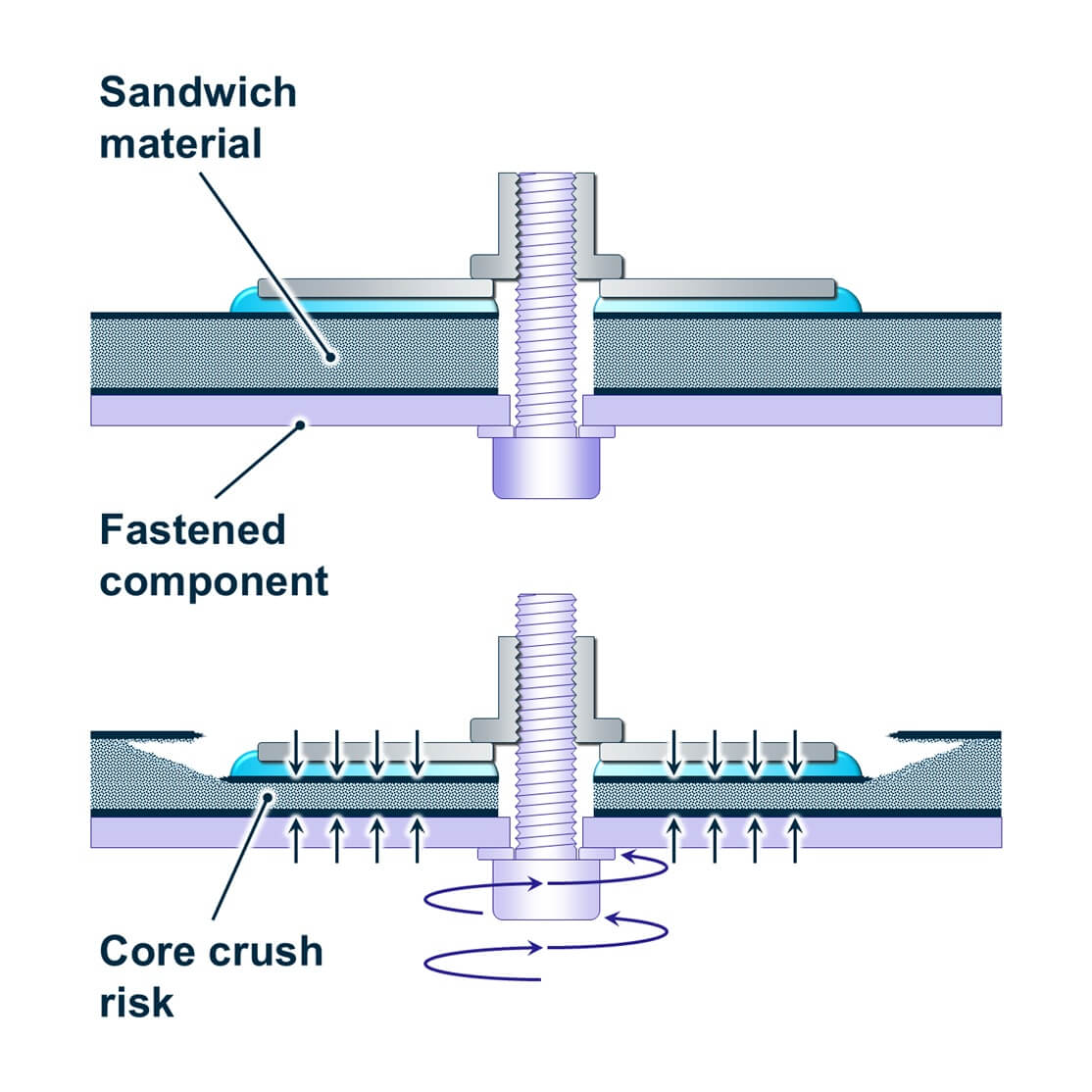
Option 1: open reverse socket
Option 1: open reverse socket
Advantages:
- No stand‑off between components
- No risk of skin disbonding
Disadvantages:
- Core material is compressed during assembly
- Requires extremely precise torque control (<1 Nm)
- High risk of crushing the core
Option 2: open socket
Option 2: open socket
Advantages:
- No compression of the core during assembly
- Compatible with standard bigHead tightening torque guidance
Disadvantages:
- Creates a stand‑off between components
- Risk of skin disbonding
- Adhesive overspill must be managed carefully

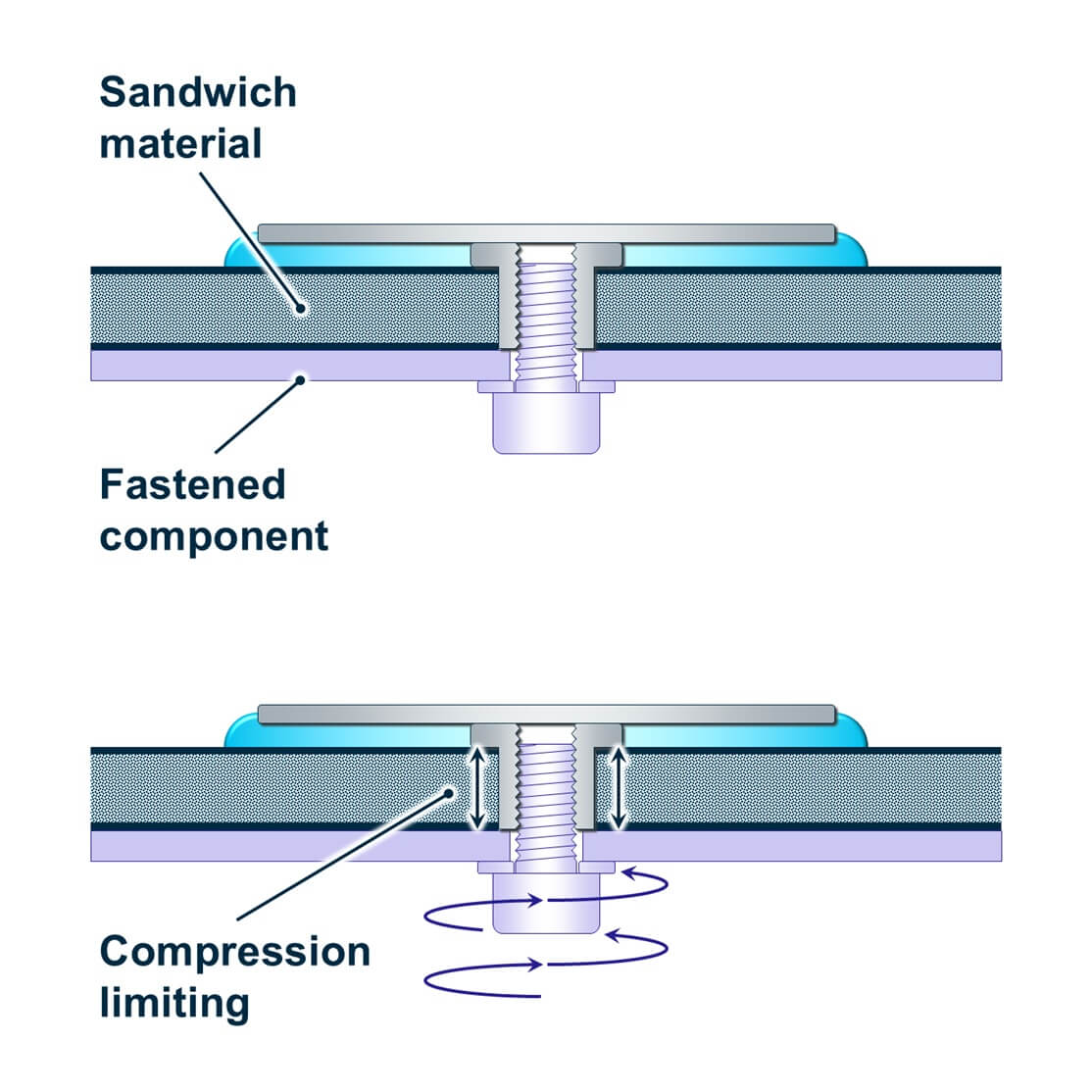
Option 3: blind socket
Option 3: blind socket
Advantages:
- The fastener takes the compressive load, not the sandwich panel
- Reduced risk of compressing core material during assembly
- No risk of skin disbonding
- Compatible with standard torque guidance
Disadvantages:
- Thread length must match the sandwich thickness precisely
This was the only option that fully protected the structure while meeting the customer’s assembly and performance requirements.
The solution: a customised blind socket fastener
The customer selected option 3. We recommended a bigHead blind socket with a customised thread length to match their ~5.5 mm sandwich panel.
This configuration ensured:
- The fastener, not the sandwich structure, carried all compressive loads
- No crushing, disbonding, or fatigue risk
- Clean internal surfaces suitable for medical payload equipment
- A lightweight solution aligned with UAV performance requirements
Even though they were only building ten units, the design needed to be right the first time, and fast. The customised bigHead allowed them to move confidently from concept to prototype in a matter of weeks.
The outcome: a safe, lightweight fixing
The customer told us they were thankful for the clarity the process gave them. By guiding them through the decision, we helped them:
- Avoid a fastening method that would have crushed the structure
- Understand the trade‑offs between different configurations
- Select a lightweight, load‑spreading solution
- Reduce cognitive load during a high‑pressure design phase
This is why we do things differently to other fastening manufacturers. We won’t just send you some samples and leave you to figure things out on your own. We’re here to help you make safe, informed engineering decisions.